
What My Blind Dog Taught Me About Confidence, Joy, and Slowing Down
When people first meet Big Blind Bear, they usually say one of two things:
“I’m so sorry…” or “I would never guess he’s blind.”
And honestly? Both reactions make sense.
Before Bear came into our lives, I thought blindness meant limitation. Fear. Fragility. I imagined a dog who needed constant protection and lived cautiously. What we got instead was a teacher — one with four paws, an incredible nose, and more confidence than most humans I know.
Blind Doesn’t Mean Broken
Bear doesn’t know he’s missing anything.
He doesn’t wake up thinking about what he can’t see. He wakes up thinking about breakfast, sniffing the air, finding his favorite toy, and making sure I’m exactly where I’m supposed to be. His world isn’t smaller — it’s just built differently.
Blind dogs don’t live in darkness the way we imagine it. They live in scent maps, sound cues, routines, and trust. And once I stopped projecting my fears onto him, I realized something powerful: he was never the one who needed reassurance — I was.
Confidence Is a Skill You Practice
Bear walks into new spaces with his head up. He pauses, listens, takes a few sniffs, and keeps going. He bumps into things sometimes. He recovers. He adapts. He doesn’t spiral or give up.
Watching him has completely reframed how I think about confidence.
Confidence isn’t knowing everything will go perfectly.
It’s trusting yourself to figure it out when it doesn’t.
Bear doesn’t wait for permission to enjoy life. He doesn’t apologize for moving at his own pace. He just… lives.
Slowing Down Is a Gift
Life with a blind dog forces you to slow down — and that’s not a bad thing.
We take intentional routes. We use consistent words. We celebrate small wins. Walks are less about distance and more about experience. You notice the breeze, the sounds, the rhythm of steps.
Bear taught me that slowing down isn’t falling behind.
It’s actually how you notice what matters.
Why Big Blind Bear Became an Influencer
Bear didn’t become an influencer because he’s blind.
He became one because he’s joyful, resilient, and unapologetically himself.
If sharing his life helps even one person see disability differently — or helps one family say “yes” to adopting a special-needs dog — then it’s worth it.
Blind dogs don’t need pity.
They need understanding, patience, and a chance.
And if Bear has taught me anything, it’s this:
✨ You don’t need perfect vision to live a full, beautiful life.

A Different Kind of Normal: Why Bear Isn't "Missing" Anything
When people meet Bear for the first time, their reaction is often one of pity. They see his unique face and assume he lives in a world of confusion or fear. But those of us who know him—know the truth is much more beautiful.
The Question We Get Most
One of the biggest questions we get is, "Is he sad he can't see?" The truth? Bear doesn't know he's "missing" anything. Because he was born blind, the dark isn't scary to him—it's just home. He doesn't grieve for sunsets he’s never seen; instead, he celebrates the fuzzy texture of his favorite tennis ball, the smell of the morning air, and the sound of a treat bag opening from three rooms away.
While dogs who lose their sight later in life have to "re-learn" the world, Bear was a master of his other senses from the start. He taught us that "disability" is often just a label we put on things we don't yet understand.
A Life of Simple Joys: Sniffing, Snoozing & Tennis Balls
If you want to know what a "perfect" day looks like for Bear, it’s a beautiful mix of sensory magic:
The Tennis Ball Obsession: He might not see the ball fly through the air, but he is a pro at "hearing" where it lands and "sniffing" it out of the grass. The joy he gets from a simple tennis ball is proof that you don't need eyes to play.
Professional Level Smelling: To Bear, a walk is a "smell-walk." His nose is his GPS, his newspaper, and his entertainment all in one. He can spend ten minutes investigating a single blade of grass, and we let him—because that is how he sees the world's beauty.
Expert Napping: Once the sniffing and playing are done, Bear is a world-class napper. He can find the warmest sunspot on the floor or the softest corner of the couch with unerring accuracy.
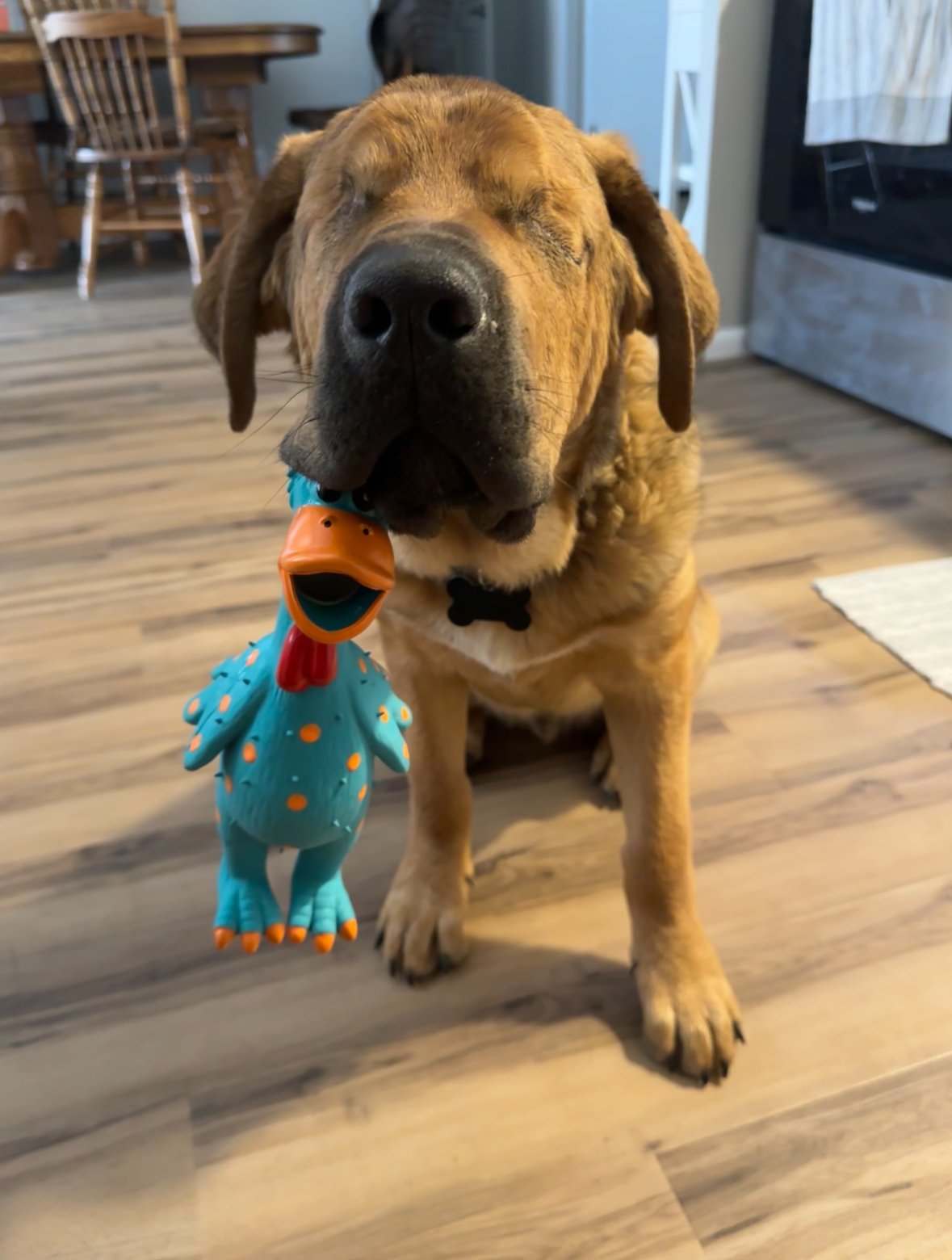
Seeing with the Heart
Bear doesn't need to see my face to know he’s loved, and I don’t need him to see me to feel his loyalty. He has taught us to slow down, to breathe in the world around us, and to appreciate the magic in the things we usually overlook.
Disability isn't a lack of ability; it's just a different way of experiencing the world.

🎁The Ultimate Blind Dog Christmas List: 7 Sensory Gifts for a Happy Holiday
Giving the Gift of Confidence
The holidays are a perfect time to shower your dog with love, but for visually impaired dogs like Big Blind Bear, a standard squeaky toy might miss the mark. The best gifts aren't about what they can see, but what engages their magnificent nose and ears!
We've compiled Big Blind Bear's personal Christmas list, focusing on enrichment toys that boost confidence and provide hours of satisfying, nose-first fun.
👃Gifts for the Supreme Sniffer (Scent-Focused)
These gifts are low-impact, mentally tiring, and deeply satisfying, allowing your dog to "read" the world through their nose.
-
Why it's a great gift: A snuffle mat turns mealtime into a puzzle! It's the ultimate low-impact mental exercise. Look for one with varied textures and deep pockets for a real challenge.
Big Blind Bear's Recommendation: We use this sturdy, machine-washable mat for daily feeding! Check it out here on Amazon.
Big Blind Bear's Tip: We use our snuffle mat for their morning meal every day. It slows down eating and starts the day with a confidence-boosting "win."
-
Why it's a great gift: This is the equivalent of a human getting a coding class! Scent work is incredibly enriching and builds massive confidence in blind dogs. We highly recommend the Hide & Scent Standard Edition kit. It provides everything you need—scent bottles, tins, and clear instructions—to introduce formal nose work safely.
Find it here: Hide & Scent Standard Edition Link
Big Blind Bear's Tip: Start with a simple tin placed directly by their food bowl, then slowly move it farther away. This is an incredible bonding activity for the whole family!
🧠Gifts for the Brainiac (The Puzzle Challenge)
Puzzle toys are excellent for building confidence by rewarding successful manipulation and scent tracking. The golden rule is to start at Level 1. If you jump to a difficult puzzle too soon, you risk frustrating your dog and reducing their willingness to play.
-
Focus: Simple lifts, nudges, and flips. Ideal for beginners or senior dogs.
Recommendation: Level 1 Puzzle Link on Amazon
-
Focus: Requires multi-step problem-solving (e.g., sliding pieces then lifting pegs). Only move to this level after they master Level 1!
Recommendation:Level 2 Puzzle Link on Amazon
-
Focus: Complex combinations of moves, often requiring rotation or multiple openings. Great for highly motivated dogs who need a serious mental workout.
Recommendation: Level 3 Puzzle Link on Amazon
👂Gifts for Active Ears (Sound-Focused Play)
These gifts encourage movement, chase, and independent play without relying on sight.
-
Why it's a great gift: For the dog that still loves to chase! Look for a toy that emits a consistent, loud sound or has a powerful rattle that activates on motion. They're super durable and perfect for pups who like to run and locate their toy by sound.
Recommendations:
Interactive Teaser Ball: The Jolly Pets Teaser Ball is an incredibly durable, hard plastic ball that rattles and tumbles. This is one of Bear's favorites! Extremely durable.
Giggle Ball: The Pets Know Best Wobble Wag Giggle Ball is a fantastic battery-free option that makes an enticing giggle sound when rolled. Bear also loves this toy!
Big Blind Bear's Tip: Only use these in a securely fenced yard or a large, clear room. Always use a clear command like "Fetch!" so they know the game has started.
-
Why it's a great gift: This is the ultimate gift for the dog parent who has to leave their blind companion alone sometimes. The Furbo allows you to monitor your dog remotely (using the camera), speak to them (using the two-way audio), and toss a treat—which has an associated sound cue—to reward them for settling or playing. The sound of the treat dispensing/tossing helps your visually impaired dog quickly locate the reward.
Recommendation: Check out the Furbo Dog Camera/Treat Dispenser on Amazon
Big Blind Bear's Tip: The Furbo is great for keeping separation anxiety low. Hearing your voice and a quick treat toss, followed by the rewarding sound, helps them associate you being away with a positive, predictable experience.
⭐ Safety Note: Remote Supervision is Key! Since visually impaired dogs can easily get confused, bump into things, or become frustrated, the camera function is essential. It is absolutely critical that you use the Furbo to supervise your dog, especially if they are playing with any other enrichment toys or if you are training them to use the treat toss. Remote supervision is a great way to ensure their safety and redirect them if they are getting into trouble.
This year, skip the generic dog toys and choose a gift that truly honors the special senses and resilience of your visually impaired companion.
Merry Christmas!
Blind-Dog Proofing Your Home: The Ultimate Safety Checklist
Welcoming a blind dog into your home doesn't mean you have to live in fear. It means you have the beautiful opportunity to create a consistent, safe environment that builds their confidence and allows their other incredible senses to take over.
Our home is their map, and consistency is the key to unlocking their resilience. Use this checklist to transform your space into a safe haven where your blind pup can thrive!
-
Resist the urge to rearrange! Once your dog has mapped the house, even small changes can cause anxiety and injury. Keep furniture, water bowls, and beds in the same location indefinitely.
-
Use distinct floor textures to provide vital navigational cues. We use different runners or rugs to signal high-traffic areas or transitions. Crucially, we place a specific type of mat or rug right by all exterior and interior doors. This gives BigBlindBear a sensory boundary, so he knows exactly when he is approaching an open doorway or exit.
I have also heard that you can use small, distinct scent markers (like a drop of vanilla extract on a door frame) to help them navigate. We have not tried this with our blind pup, the rugs work just fine!
-
Sharp corners are the most common source of injury. Use simple, inexpensive foam corner protectors on all coffee tables, shelves, and cabinets. A head bump is inevitable, but an injury is not.
Living Room & High-Traffic Areas
Remove or Pad: Glass-top tables, decorative items on low shelves, and sharp-cornered furniture (pad these!).
Edge Protection: Install foam corner protectors or, as a suggestion, use split foam rollers/pool noodles to cushion the edges of tables.
Clear the Floor: Ensure low-hanging items (like power cords, shoes, or children's toys) are always picked up and off the pathways.
Create Islands: Group large furniture items together to create clear, defined walking lanes rather than open, confusing space.
💡 Owner Tip for Extra Safety: Our dog, Bear, is naturally a cautious and methodical navigator, so we primarily use simple corner guards to cushion edges. However, you may consider using soft foam rollers or pool noodles split lengthwise to entirely cover the edges of wide, sharp tables. This method can be very helpful for dogs who are faster or less cautious in their home navigation.
Blind Dogs Can't Be Happy? 7 Common Myths About Visually Impaired Pets, Busted!
Let's get straight to the point: The idea that a blind dog is a sad dog is a myth we’re eager to dismantle. They don't mourn sight; they master scent and sound.
This post is dedicated to giving you the real, authentic answers behind the seven most common questions we receive.
We're proving that with simple consistency and love, a blind dog's life is defined by joy, not limitation.
🐶 Myth 1: They Are Sad/Mourning Their Sight.
Reality: They are not! They are masters of adaptation.
For dogs like BigBlindBear, who was born visually impaired (congenitally blind), there is no concept of "loss" or "mourning." He has always relied on his incredible nose and ears to navigate the world, and that is his normal.
Even for dogs who lose sight later in life, they adapt far faster than humans. They live in the present moment and quickly shift their reliance to their powerful scent world. Any signs of initial "sadness" or anxiety are usually just confusion from the sudden change, not grief. The best thing you can do is focus on building confidence through consistency, not pity.
🏃 Myth 2: They Can't Play Games or Run.
Reality: They can play, run, and zoomie with the best of them—and yes, they can even go to dog parks!
You just have to adjust the rules of the game to engage their powerful hearing sense of smell:
Sound Retrieval: Invest in toys with loud, distinct bells or large squeakers. Use a verbal marker ("Find it!") to encourage tracking by sound.
Scent Work: Hide high-value treats in a snuffle mat or under towels. This is highly enriching and mentally tiring!
Yard Safety: Use a securely fenced, mapped backyard for safe running.
Safe Socialization (The Dog Park): While caution is required, many blind dogs thrive at dog parks!
Use High-Visibility Gear: We always use a bright green leash that clearly says "BLIND DOG" on it. This signals other owners to approach gently.
Stay close to your dog and be their eyes—verbally warning them of fast-approaching dogs.
🤗 Myth 3: They Require Constant Carrying and Coddling.
Reality: Over-coddling can actually create anxiety.
Confidence comes from independence and mastery of their world. When you constantly scoop them up or block their path, you interrupt their internal mapping process, which is how they learn.
Be a Guide, Not a Limiter: We use a simple command like "Slow!" or "Step!" to give Bear a warning, allowing him to navigate the obstacle himself.
The Power of Consistency: Ensure all furniture stays in the same place so they can trust their internal map.
💰 Myth 4: They Are Expensive to Care For.
Reality: Initial costs are usually low, and long-term costs are often similar to sighted dogs.
The best adaptive gear is simple:
Low-Cost Gear: Foam corner guards, different texture mats, and basic bells on collars.
Highest Expense is Time: The most valuable investment is your patience and commitment to setting up routines and proofing the home.
👨👩👧👦 Myth 5: They Can't Live with Kids or Other Pets.
Reality: They thrive in busy, loving homes!
The only caution is preventing your dog from being startled, as they can't see an approach.
Teach a Cue: We teach children and other pets to approach with a clear verbal cue first ("Bear, friend!") and touch him gently on a non-sensitive area (like his back).
Safe Space: Always ensure your blind dog has a crate or bed where they can retreat for guaranteed quiet time.
🧠 Myth 6: They Can't Learn New Tricks.
Reality: They are masters of scent and sound training!
Vision is overrated when you have a nose like a dog. Training is essential for mental enrichment and confidence.
Verbal Markers: Use clear, consistent vocal markers (like a sharp "Yes!" or a clicker) to signal success immediately.
Scent Games: Teach advanced commands like "Find Mom" or "Go to Bed" using scent trails or target mats.
⏳ Myth 7: Their Life Span is Limited.
Reality: Vision loss itself does not shorten their life span.
A blind dog, if otherwise healthy, can live a full, happy, and normal dog life span.
They have a massive capacity for joy and resilience. Don't let blindness be a barrier to adopting a beautiful, loving companion!
If you needed a sign to open your heart to a special needs pet, this is it!
Blind dogs are not disabled; they are simply navigating the world differently. With a little consistency and a lot of love, they will enrich your life in ways you never imagined.
What's the most surprising myth you learned today? Share in the comments!